As Spring Arrives, Gas Prices Continue to Climb
In New Jersey, the average price for a gallon of regular gasoline rose 28 cents over the last week to sit at $3.79.
Mar 19, 2026 | Fuel
VOORHEES, N.J. (March 19, 2026) – Friday marks the official start of spring and prices at the pump continued to climb by 28 cents since last week. With the spring equinox ushering in warmer weather and more time on the road, gas prices are trending upward alongside seasonal demand. Last week’s announcement to release 172 million barrels of oil from strategic reserves over four months has no immediate relief on the oil market as the price of a barrel of crude continues to climb.
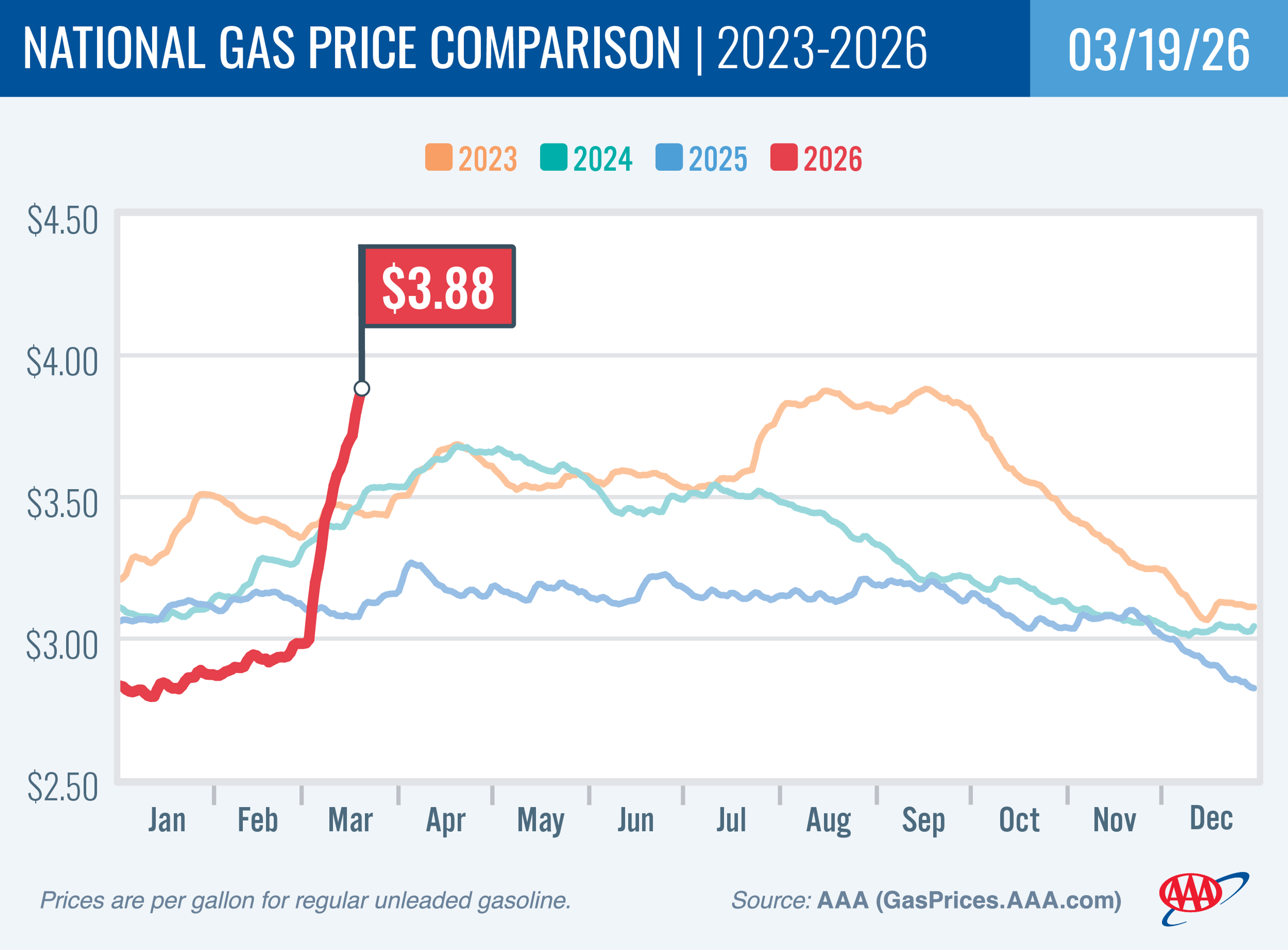
Today’s National Average: $3.884
One Week Ago: $3.598
One Month Ago: $2.929
One Year Ago: $3.102
In New Jersey, the average price for a gallon of regular gasoline rose 28 cents over the last week to sit at $3.79. A month ago, it was $2.93.
The cheapest gas in the state, on average, can currently be found in Bergen County at $3.71. Cape May County has the highest average price in the state at $3.92.
According to new data from the Energy Information Administration (EIA), gasoline demand decreased last week from 9.24 million b/d to 8.72 million. Total domestic gasoline supply decreased from 249.5 million barrels to 244.0 million. Gasoline production decreased last week, averaging 9.4 million barrels per day.
Oil Market Dynamics
At the close of Wednesday’s formal trading session, WTI rose 11 cents to settle at $96.32 a barrel. The EIA reports crude oil inventories increased by 6.2 million barrels from the previous week. At 449.3 million barrels, U.S. crude oil inventories are about 1% below the five year average for this time of year.
Fuel-Saving Tips
• Watch your speed. Fuel economy peaks at around 50 mph on most cars, then drops off as speeds increase. Reducing highway speeds by 5 to 10 mph can increase fuel economy by as much as 14%.
• Avoid excessive idling. A car engine consumes one quarter to one-half gallon of fuel per hour when idling, but a warm engine only takes around 10 seconds worth of fuel to restart. Where safe to do so, shut off your engine if you will be stopped for more than a minute.
• Regular vs. Premium. Pay close attention to the words “recommended” and “required.” If regular gas is recommended for your vehicle, that’s all you need. Choosing premium when your car doesn’t require it will only cost you money and doesn’t improve fuel economy.
• Remove unnecessary weight from your vehicle (e.g., trunk, cargo area, etc. ) as weight increases the amount of effort it takes to move the vehicle.
• Check and maintain your tire pressure. Maintaining the proper pressure will save you gas money as it takes less effort to move the vehicle and proper tire pressure decreases wear on the tires. Follow the recommended pressure as identified in your owner’s manual and/or a decal located on the driver’s side door.
• For road trips, map out your route ahead of time to avoid unnecessary stops. Pack enough water and snacks to hold you over to avoid spending extra cash on fast food.
• Take advantage of fuel rewards at gas stations.
EV Charging
The national average per kilowatt hour of electricity at a public EV charging station remained the same this past week at 41 cents.
State Stats
Gas
The nation’s top 10 most expensive gasoline markets are California ($5.61), Washington ($5.14), Hawaii ($5.07), Oregon ($4.70), Nevada ($4.66), Arizona ($4.43), Alaska ($4.42), Illinois ($4.04), Idaho ($3.98), and District of Columbia ($3.96).
The nation’s top 10 least expensive gasoline markets are Oklahoma ($3.24), Kansas ($3.24), Iowa ($3.34), Arkansas ($3.34), North Dakota ($3.35), South Dakota ($3.36), Nebraska ($3.37), Missouri ($3.38), Minnesota ($3.43), and Mississippi ($3.48).
Electric
The nation’s top 10 most expensive states for public charging per kilowatt hour are West Virginia (53 cents), Hawaii (51 cents), Alaska (50 cents), New Hampshire (47 cents), Louisiana (47 cents), South Carolina (46 cents), California (45 cents), New Jersey (45 cents), Arkansas (44 cents), and Idaho (43 cents).
The nation’s top 10 least expensive states for public charging per kilowatt hour are Kansas (29 cents), Missouri (31 cents), Utah (33 cents), Maryland (33 cents), Nebraska (33 cents), Iowa (34 cents), Vermont (34 cents), South Dakota (34 cents), Delaware (36 cents), and Colorado (38 cents).
Drivers can find current gas and electric charging prices along their route using the AAA TripTik Travel planner.
About AAA
Started in 1902 by automotive enthusiasts who wanted to chart a path for better roads in America and advocate for safe mobility, AAA has transformed into one of North America’s largest membership organizations. Today, AAA provides roadside assistance, travel, discounts, financial and insurance services to enhance the life journey of over 63 million members across North America, including 56 million in the United States. To learn more about all AAA has to offer or to become a member, visit AAA.com.